Sunday, July 28, 2013

West Crete windsurf spots

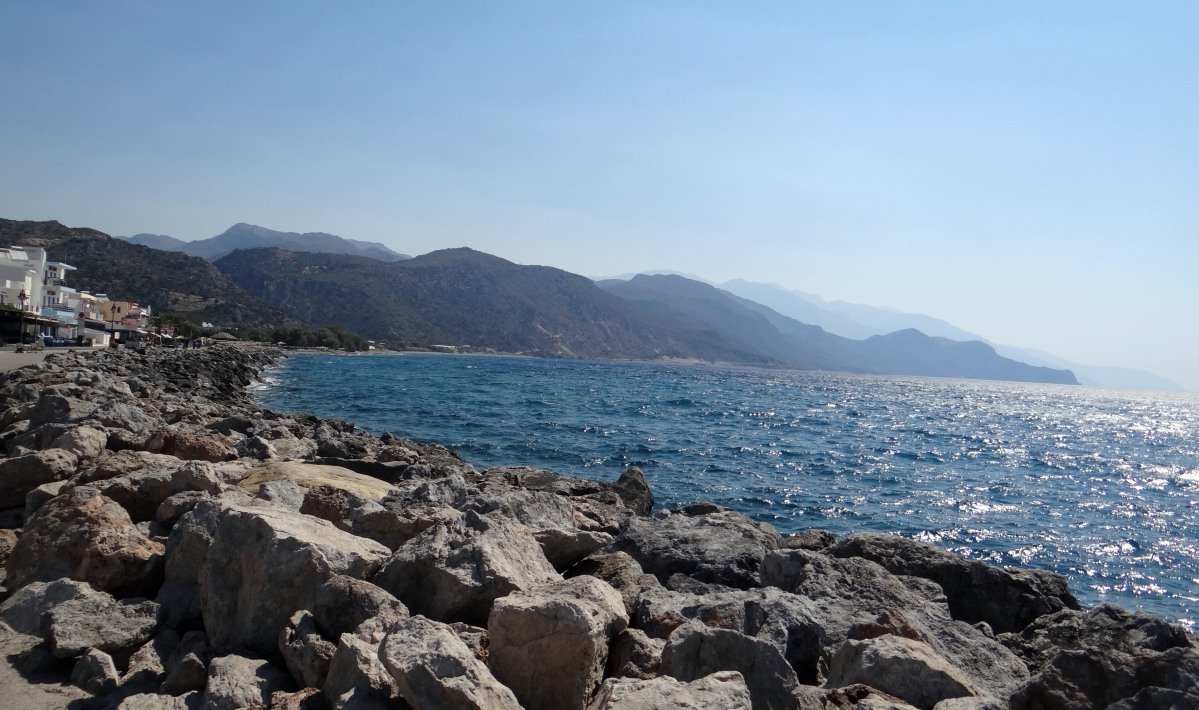
Beside the unique beauty, Crete offers a lot of places for windsurfing. After exploring east and south, I checked the west coast of Crete. With the little help from all-knowing Google, it was not hard to get basic information about where the wind could be found. I was surprised, but Chania area is quite windless during summer. Fortunately, from there some nice windsurfing spots could be reached in less than an hour drive.

Paleochora

Beautiful village on the south-west coast. Good road takes you from Chania right in the middle of it, crowded with tourists. There is a note on the internet that once Paleochora was better windsurfing spot, with some Centers there, but winds started to be irregular and people left. When I came, the wind was from northeast direction and quite gusty. Still, on the east side of Paleochora, in front of the harbor, it was quite strong, with amazingly choppy water.

On the west side, there is a long sandy beach, with flat condition but not so strong. I suppose it could be good for beginners, but I didn't see anyone windsurfing there.


Falasarna

Half an hour from Chania, to the west, there is an amazing long sandy beach in Falasarna. A lot of tourist, though, enjoying the crystal clear waters and white sand. Wind from north direction, good for bigger sails, but again nobody windsurfing. Well, it was anyway less windy day, but I could imagine this place is ideal when there is more wind. During tourists season it could be difficult to get in the water, but once in, there is enough space for long rides all around.

Breathtaking view on Falasarna beach is worth stopping by the road and enjoy for a while.


Elafonsi


The most difficult place to reach. It doesn't matter if you go around, down from Falasarna, following the steep west coast, or you take the road to Paleochora and than turn right in some small village (there are visible signposts around, it is unlikely that you will be lost), you are bound to get dizzy from the serpent like narrow road which follows the mountains slopes.

But, in the end, when you finally get there, it is all paid for! Elafonsi is a real pearl! This is an unique beach made from few connected natural basins. Inside them, the water is shallow, light blue, almost white on some places. And full of people, of course. So, you can forget windsurfing inside them during high season. There was some beginners, though, learning to windsurf in perfect condition for them.

On the left side of the basins, there is enough space for windsurfing, all the was east to the nearby much bigger bay. When I was there, the wind was northeast direction, which is, as I understand, not often so. More usual wind is northwest, it seems. But, anyhow, you get the flat water and a lot of space for fooling around. It could be good for speeding, too, when the wind is stronger.


All summed up, west coast of Crete is very windsurf friendly, especially if you are not too demanding about perfect conditions and everyday wind. If you add to that amazing Cretan cuisine, unbeatable scenes of mountains, gorges and the see, you get charming combination you don't want to miss!


Monday, July 22, 2013

What Is Your Heart Doing While You Are Windsurfing?

Previous article from the same series: High Maximum, Low Minimum

I admit, two previous articles were written rather technically. I hope they will be of some use to you. The main point was: keep your heart rate down, as low and as often as possible.

However, while I believe that this is valid for conditional training and general fitness, windsurfing is something else. Do you know what is your heart doing while you are windsurfing?

I would like to share with you my experience during the last couple of months. I am not sure I can explain what is happening and what the significance of this numbers is. See for yourself or, better, check it for yourself, and share with us.

It is not enough to say that I was surprised by the numbers – the right word was: shocked! Namely, it was enough for me just to approach my windsurfing equipment and HR was over 100 bpm! During rigging, it is around 120, peaking at 130 or even more. Just rigging!

I thought that I am in quite good shape. I am doing my exercises (biking and gym) averaging on 60% HRmax – 125 bpm. In windsurfing, it seems that I am there without even getting wet!

Now, while actually windsurfing, my heart averages (during 90 minutes of windsurfing) from the same 60% (125 bpm) up to 75% (142). That is more than I expected, because that includes periods of resting.

Once, during one hour of pure windsurfing in moderate to strong wind (25 knots), average was almost 80% (145 bpm).

When you look at the peaks – they go up to 103% of HRmax (172 once) and many times around 160. The peaks happen during jibes, speed runs and gusts (in that order: a power jibe and speed run will almost for sure get you over 90%, and gusts will increase HR for sure).

During windsurfing in straight line, I was sometimes able to keep HR around 60% (120-130 bpm), but mostly it was higher (135-145 bpm). I am not sure I noticed any connection with the strength of the wind by itself, but gusty wind, even moderate or light, will increase HR.

Also, I have noticed many oscillations in HR. It is all over the place, so to say – quite different from other excesses like biking or running. I suppose that is due to a lot of anaerobic activity which happens during static effort, short bursts of energy in gusts, jibes and speed runs.

And, what surprised me the most: when I am on the bike and getting 147 bpm, that is 80% of my HRmax, I am breathing heavily, gasping for oxygen and cannot endure such effort for longer than a minute or two. When windsurfing, and pumping with that HR, I am ok, easy, relaxed, breathing through nose and happily surfing around for as long as I wish!

Now, as I said, I have no sure explanation why this happens. There are no available data (at least I could not find them) about HR and windsurfing. One of my speed surfing friends once told me that he used a heart rate monitor for a while, but then he gave up, because "he could not stand to look at such high numbers". Also somebody told me (but I didn't see the paper) about comparison of heart rates in wave, freeride, freestyle and slalom. According to that word of mouth, slalom windsurfers had the highest heart rate, especially during turning around the mark.

I can try to explain some of it by attributing high heart rate to adrenalin rush which we all get from windsurfing. Because, it is obvious to me that beating 145 bpm while windsurfing is not at all the same as keeping that rhythm in other sport activities.

Of course we like excitement – that's why we are windsurfing. However, putting that aside, the fact is that our heart is working hard during windsurfing, and that opens some very important questions, especially as we get older.

First of all: are we ready for windsurfing? The effort of windsurfer’s heart is probably equal to the effort of some professional athlete. And we don't have the same preparation, the same level of fitness, etc. We should have it, though! If my HR readings are at least partially applicable to an average windsurfer, than preparation for such activity must be more serious, especially if you don't want just to go out couple of times per year, but rather to actively improve your skills, speed, etc.

And, second, what about lowering heart rate during windsurf? Is this idea applicable to that kind of sport with so much up's and down's, turns and twists? I believe it is. Peaks will probably not go away, but in general, lowering the average should be possible. Exactly how to do it, that is what I intend to find out during a time to come.

See the example windsurfing session with interactive map, heart rate and speed under title: Warm up more!


Saturday, July 20, 2013

Some happy moments - Kouremenos, Crete

Some happy moments from Kouremenos, Crete.


Although, the wind is very gusty and there is always a dilemma what sail to use...


...there is enough beauty around to make a windsurfer smile!


Cheers!

Tuesday, July 16, 2013

High Maximum, Low Minimum

Previous article from the same series: The Rhythm of the Heart

The goal of efficient athlete is to have a capability of high maximum heart rate, and as low resting heart rate. John Douillard says: "As we age the heart just cannot beat as fast as it used to. At the same time, the resting heart rate starts creeping up, bringing these two numbers closer together. One of the classic ways of measuring youth, overall health and cardiovascular status is to have a low resting heart rate and a high maximum heart rate."

Maximum heart rate (HRmax) is usually calculated by formula 220 – years of age. It can be measured, though, more precisely (the most accurate way of measuring HRmax is via a cardiac stress test: an exercise monitored by an ECG), but I doubt that average recreational windsurfer will go through that procedure. So, you are quite safe with the number you get with this formula. For me, that would be 169 bpm (beats per minute). Of course, chronological age is measured by calendar years, but this may not be a good reflection of fitness and health. We all know people who appear much younger—or older—than their chronological age. From Wikipedia: "…note that individuals of the same age, the same training, in the same sport, on the same team, can have actual HRmax 60 bpm apart (160-220): the range is extremely broad..."

Resting heart rate (HRrest) is heart rate measured after, let say, good sleep. You may stay a little longer in the bed in the morning, attach your heart rate monitor and measure the beats. Notice the lowest number – that is resting heart rate. Usually it will be around 60 to 80. If you are very fit, it can be less, even less than 50. Also, with exercising the number will go down.

I am not feeling safe to recommend (or to practice myself) any specific exercise aimed at increasing the capability of high heart rates. Of course, this will happen by itself with improved health and fitness. Since the efficiency usually demands lowering heart rate, let's focus on this.

As far as I can see, today’s recommendations also point to lower heart rates than we used to think. For example, exercising on 65-75% of your max heart rate is considered healthy. John Douillard and his zone training would put that even lower, actually so low that when you first time start to do it, you would probably think that you are doing nothing!

Douillard method is quite similar to old Karvonen formula based on resting heart rate (HRrest) in order to calculate target heart rate. However, while others aim at 85%, in zone training you will go for not more than 60% or 75%, while the best excersize will stay at targer heart rate (THR) of 50% (in the begining, it can be equal to stand up and walk!).

Here is Karvonen formula:

THR = ((HRmax − HRrest) × % intensity) + HRrest

My resting heart rate during last couple of months is fluctuating between 54 and 62, let say averaging 61. HRmax according to simple formula mentioned earlier would be 169.

50% Intensity: ((169 − 61) × 0.50) + 61 = 115 bpm
75% Intensity: ((169 − 61) × 0.75) + 61 = 142 bpm

I have examined, at least by reading, many different training methods. You may do the same. But whatever you do, my recommendation is that you try and keep your heart rate as low as possible. Heart is a muscle and it can be trained to do many things. If you train it to beat very fast when you walk, it will do so. If you train it to go over 150 bpm every time you start running, it will do so. We may think it should be like that, or that it is given by nature, but it is not completely true! Many things, including heart efficiency, can be changed.

I don't want to go into details of some specific training (I might do that in some other articles, although you are free to use whatever you find suitable), but my recommendation (and that is what I do) is to use your ability to control the heart rate via biofeedback-awareness link and make it lower in any case!

For example, I used to do 45 minutes biking exercise with average 125 bpm. That was the constant average for more than six months. I believe my physical fitness was improving just by doing it regularly three times per week. But the average bpm were the same. After only ten days of paying attention to heart rate, I was able to lower it to 118 bpm average, and it seems that I can do even lower. I am not talking now about improved physical condition (training and exercising is the only way to do it), but about the power of attention! That is what makes the difference, and what will, in the end, tell your heart that it can do the job without straining so much.

That is why it is important to use heart rate monitor. Sometimes, just watching it and wanting it to be lower, can do the trick. Sometimes, stopping when you see it goes too high is enough so the next time it will not do it. Breathing techniques can be of great help. I will go into that in later articles.

Whatever your chosen method of training is, do it with at least couple of heart beats less. As I said, with the training it will happen by itself, but using the heart rate monitor as a biofeedback, will make it quicker. In time you will learn to do it even without an intermediate device (heart rate monitor). Of course, if you see that your chosen method of training demands from your heart very high numbers, and there are no signs of going down, it would be wise to reconsider what are you actually doing and why.

There is one useful thing you can do with the resting heart rate. It will change from time to time, even from day to day. To measure it, it’s not necessary time consuming. Although it would be ideal to measure resting heart rate at least 10 or 20 minutes to get real number, for everyday use, you will learn to estimate if the heart rate is average, lower or higher in a very short time (one to two minutes is enough to get an idea). If you notice that it is unusually high, skip the hard exercise that day. Do just warm up or something lighter. High resting rate in the morning may be the sign of stress and fatigue in your body that you might not be aware of. Hard exercise in that condition may do more damage than good, decrease your enjoyment significantly and thus hamper your path towards the zone.

Next article from the same series: What Is Your Heart Doing While You Are Windsurfing?

Monday, July 15, 2013

Ierapetra and Koutsounari, Crete

I wanted to see the south cost of Crete and check how is the wind there. From Palecastro and famous Kouremenos beach, to Ierapetra, you have to drive about 80 kilometers through quite good pawed road and beautiful scenery of Cretan hills full of olive trees.

When we came to Makry Gialos, the first little village on south coast, the wind was blowing with amazing force (some 40 knots, at least). I don't know if that was a meltemi wind, or some local thermal wind prevailed. The direction was pure north. And some 5 km further down the road, there was no wind. Near Ierapetra, again quite strong (30 knots, at least).

In Ierapetra, the southernmost city in Europe, you can windsurf on the main beach near the old forest and the heart of the city. It is easy to come with the car and park it nearby. Assembling the equipment is another story, because the beach is full of people, and the is no windless place to find. The conditions on the see - bump and jump, perfect for freeriding and freestyling. For slalom and speed - only if you feel particularly masochistic that day.


My greatest discovery, however, was the Long Beach in Koutsounari, small village couple of kilometers east from Ierapetra. This is about 3 km long, strait, sandy beach. Half of it is reserved for swimmers, and the other half is free. The wind was wild: between 50 and 60 knots. It blows offshore, and the first 10 meters of see surface is laboratory flat! After that, chop and see dust: I imagine you can get in serious trouble if you forget where you are and let yourself too far out. I didn't have small enough equipment to try to catch some speed on it. It is a pity because this was the first time ever I saw live (not on photos or videos) such long speed stripe, with such strong wind and yet, flat water surface. If I will be lucky, maybe some of this days I will visit Koutsounari again.